By James Gawley
Thanks to NetGalley, the publisher and the author for the opportunity to read and review this ARC.
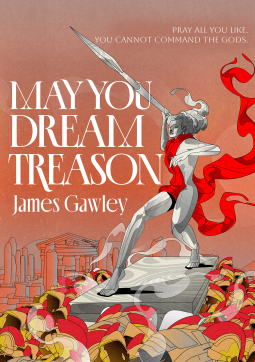
An extra special shout out to Bannermen Books They enjoyed my review of Magic City Mayhem so much they reached out and offered me an ARC of another of their upcoming releases –May You Dream Treason by James Gawley. I love a historical fantasy and the blurb plus the author’s bio was intriguing. When the book arrived I had to hide it from my husband who wanted to read it first.
Dr Gawley has a PHD in classics, the Roman kind, but all classic studies plus Roman based fantasy is SO HOT right now (insert eye roll, as if I didn’t devour Pierce Brown’s Red Rising books earlier this year). I have done my Classic 101, so I have a little familiarity with the Roman classic literary tradition – mostly The Aeneid and Seneca’s works, and a lot of sword and sandals fantasy fiction. But, you don’t need to know anything about the Roman empire to get pulled into the story and world of this novel. Gawley has used his extensive knowledge to create a historically based world that is all Roman except for the place name and the people without misappropriating the culture and beliefs of the Romans or the peoples that were contemporary with that civilization. He does not use the names of Roman gods, although the pantheon would seem familiar to those who know. He doesn’t name the “barberian hordes” at the door, although they share some behaviours, both mythic and anthropologically accurate with many peoples of the times.
What the reader does get is a fascinating descriptions of daily life, of worship, of family structure and art, architecture and political hierarchy which never feel like an info dump. It’s always mixed into the story in a way that you don’t want to skip forward. It does make the reading slower than usual but only because I enjoyed taking the time to read everything. The history and background is as fascinating and rich as the story itself. There are some comparisons to the works of Guy Gavrial Kay and I think that’s an apt comparison.
The novel takes place in the fictional republic of Arcadia, a political state in the decline of its political hegemony. The senate has given over democracy to a single populist dictator, Tiberius, in response to an external threat. The plebian class, or the lower classes, have always been uneasy with the patrician, or aristocratic, senate, the proletariat class, or the middle class, if you will, is upset that their guilds and livelihoods are under threat and not offered protection or representation in the current government. The provincial governors and landowners are unhappy with having to support the city when the rulers will not protect them from the Barbarian threat of warriors and tribes that are burning their fields and killing their homesteaders. Then there is another rebellious force that was pushed out of the city and has been sitting in the surrounding wilderness, building their forces, uniting with the tribes and waiting for the right time to invade the city and take back the power from the corrupt senate and their dictator.
In this context we are introduced to the three main characters, Primus Seneca, a young man, son to one of the rebellion’s generals and newly conscripted to the rebel army. Lilith Fabian, the unmarried daughter of a provincial governor, who runs the province under his name, which is about as much power as a woman can hold in this empire. Mathis Caelo, the middle aged grandson of a slave, who has clawed his way up the ranks to become the Tribune of the people and the dictator’s bulldog, meting out brutal justice and getting his hands dirty where the Dictator will not. Each character is affected by Arcadia’s failings in their own unique ways, while also coming to terms as to the value of their lives within.
Lilith is caught between the needs of her province and small town, having grown prosperous over the years through the engineering ingenuity of Arcadians but also under the yoke of the capital city that would sacrifice lives in the country over the rich patricians of the city. But as a woman, and unmarried, with her father’s wife about to give birth to the heir that will supplant her, she is trapped between protecting the people and becoming a pawn for political gain. The more she pushes against the powers the more she risks, and as a woman without the protection of her father’s governorship she has everything to risk if she missteps.
Primus is just a boy, barely a legionnaire, who wants to prove to his father that he is worthy. But he is plagued by fear and questions of morality. Where is his place among the rebellion army, he who was raised as a general’s son, among the children of the rebel leader. If duty goes against one’s heart, is that cowardice? Primus is the embodiment of every young adult, thrown into the real world and realizing nothing is so simple as it seemed. He is just looking for the heroes of his youth everywhere and they are all less and more what he believed.
Mathis worked is way through the military hierarchy and put in his life in with Tiberius early in his veteran career, working the political angles to be elected tribune and a man to be feared by any who dared think of supporting the rebellious ex-consul. Senators were forced to relegate land to the cause and coffers of the government if they stood against the dictator and Mathis was his tool to making them do so. Mathis grandfather fell into slavery, his father born into it and swindled his way out of it, and his mother was a slave and foreigner He must walk a razor thin edge of politics and influence to keep his position secured and is only there due to Tiberius’ protection which allows him to make bold moves. He learns too late that choosing political alliances over personal only leads one to a lonely position when people can change sides and allegiances so easily. Will he eventually run out of political good will?
Surrounding each characters inner struggles, there is a world of slavery and starvation, conquest of lands and ignorance of the world around them, awakening an anger they do not understand. The political world shifts drastically under their feet especially in light of a collapsing democracy. As each character is beset by their own demons and lack of choices, Gawley never dwells on the inner monologue. The characters even in their uncertainty continue to take action after action so the plot never stalls out.
I really enjoyed Gawley’s writing style, it was engaging and I never felt that I was reading a “boys” book, which, unfortunately, many sword and sandal books can devolve into. Lilith’s story passes the Bechdel test with flying colours, without becoming a cheap “feminine rage” storyline. The inequalities that the characters face is obvious but layered in rich subtext so it becomes integrated in the story.
The only thing that is holding me back from a 5 start review is my need for romance. I get it, it’s my thing and each character has either an affair or a hopeful wish but I just feel that I wanted more. What little there is is done so well, that I commented on it with my fellow readers, but I would have liked more than one scene. However, a reader’s mileage may vary and I gave this book a well earned 4.5 and a high 4 in apps that don’t have partial stars.