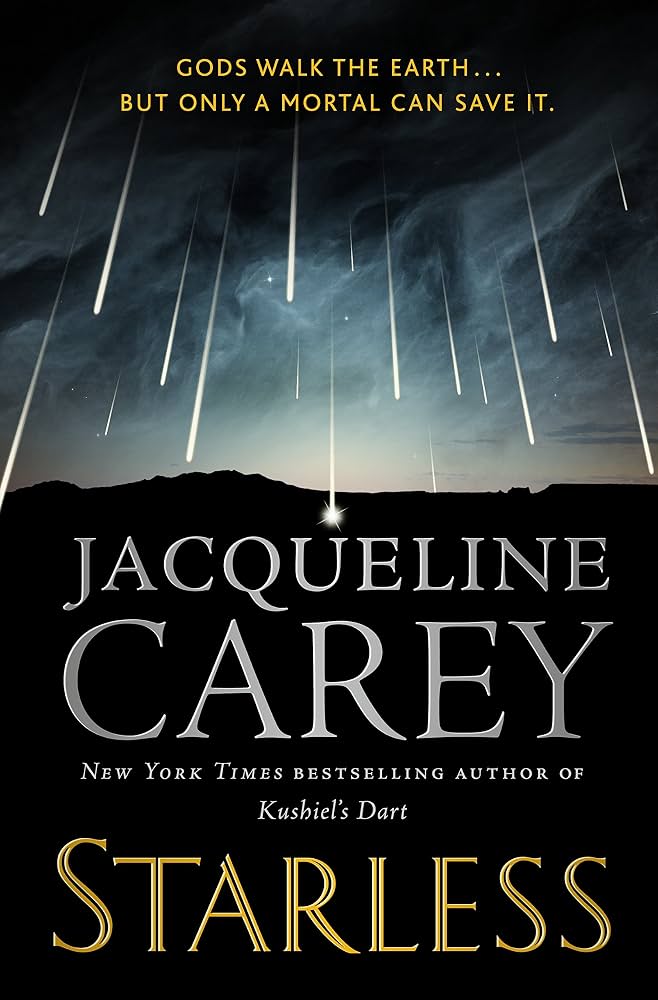
Sun-Blessed Zariya of the House of the Ageless is born during the lunar eclipse, when Nim the Bright Moon obscures Shahal the Dark Moon, and so too is her shadow, Khai, chosen by the falling of a hawk’s feather. Raised to adulthood in the Fortress of the Winds by the Brotherhood of Pahrkun, Khai becomes a living weapon: strong, fast, agile, deadly with the three-pronged kopar and the long, curved yakhan. And though deadly intrigue and dire prophecy swirl around the Sun-Blessed and the House of the Ageless, it’s Khai’s own nature that troubles him most…
From this point forward be spoilers. I have tried to keep them to a minimum.
I want to start by acknowledging my biases. First, I love Jacqueline Carey’s work. Second, I hate fated mates. This presents something of a difficulty, since this is very much a fated mates story for better or for worse, and it’s very much a Jacqueline Carey story for better or for worse.
Carey’s best work creates deep layers of character by allowing the story to grow with them. The world changes as they grow up and their understanding of it matures along with them. The reader gets to come along for the ride, and by the time the dominoes start to fall the reader knows what they are and how they got there.
I find fated mates mostly antithetical to romantic fiction. The development of the relationship is the point, and when the two lovers fall instantly, permanently, perfectly in love at first sight, what’s there to develop?
What’s surprising to me is that I liked the fated mates stuff and didn’t love the Carey stuff. This is a good novel, but the persistent Careyisms meant it would have been a great duology. I want to say that directly: Starless is good. Maybe it’s very good. I’m probably going to spend more time talking about why it’s not great than why it is good.
What It Is:
Starless is a coming-of-age epic adventure set in a world inspired by the Golden Age of Islam, Zoroastrian Persia, and south Asia and Oceania by way of classic fantasy. It’s told from the perspective of Khai, a desert warrior raised to be the soul-bonded bodyguard of a princess. Within this epic adventure nests a rare bird indeed: a slow-burn fated-mates queer romance.
Desert, Where the Mystics Are:
“Once upon a time, there were stars in the night sky,” he began again. “Thousands and thousands of them, shining bright as diamonds. And those stars were the flashing eyes and teeth and the fierce beating hearts of the thousand children of Zar the Sun, Nim the Bright Moon, Shahal the Dark Moon, and fickle Eshen the Wandering Moon, and we revered them all.”
Like many of Carey’s other stories, this one starts in childhood, immersing us in Khai’s upbringing in the Fortress of the Winds as he follows the guidance of the Seer and the older Brothers, learning the skills that will serve him through the novel. Unlike many training arcs, this one allows Khai to earn his abilities with successes and failures across a span of years. There’s a real foundation being laid; it’s not just some smirking and grunting and then suddenly Khai is the deadliest bitch on legs. He is the deadliest bitch on legs, but he earns it over long, hard years of struggle.
Khai’s incubation in the desert gives us few opportunities to look at the wider world, but Carey makes the most of them. The later section at court is lightly foreshadowed via an encounter with a child-molesting soldier seeking to have his crimes expunged via combat. Khai wrestles with his conscience; what if the soldier wins? His crimes—heinous crimes—will be forgotten, and Khai will have to call him Brother. Fortunately righteousness prevails with assistance from the divine in the person of the Seer, Khai’s mentor and the leader of the Brotherhood.
Divinity is a massive part of Starless. The children of Zar the Sun, the stars that filled the night sky, rose against their parents, seeking freedom. They were cast down to the world, emptying the sky of its light, and where they fell they abide. The desert of Zarkhoum is the way it is because Pahrkun the Scouring Wind and Anamuht the Purging Fire call it home, and when the light is clear a lucky viewer might see them striding across the desert. When the gods appear, and they do with regularity, they’re a pleasing mixture of alien and human. Pahrkun’s form is of obsidian boulders, corpse-beetles and other creatures of the desert, cloaked in blowing sand; water runs down the slate-grey skin of Ishfahel the Gentle Rain, and she unhinges her jaw to reveal a cool spring in a mountain pool; the eight golden arms of Galdano the Shrewd weigh offerings and make bargains in his temple as he gazes across the harbor.
This is a world that’s designed for and around them in really cool ways. One of my favorite moments is when Anamuht the Purging Fire appears in the City, trailing her gown of flame; the King calls out the fire brigade, the special one that exists to follow her, putting out the fires she inadvertently causes. Each land has its patron and takes its character from them: princess Zariya’s suitor Rygil comes from Therin, where it’s rude to say what you mean, and gives honor to Ilharis the Two-Faced to say one thing and mean another. In Drogalia, Quellin-Who-Is-Everywhere can be anywhere and anyone, save for their tattoos, so each Drogalian has their life’s history written on their body.
There was never a moment when the gods appeared when I was bored, and one of the key moments in the opening of the novel is Khai’s meeting with Pahrkun himself, confronting the god and his own identity in the spirit of perfect trust.
Oh, yeah, Khai’s identity.
Khai doesn’t know it, not initially, but it’s not a secret from the audience, either: Khai is bhazim. Born a girl, he was raised in the Brotherhood as a boy, unaware of his true nature. And it’s devastating when he learns the truth. His identity is so bound up in being not just a warrior, but part of a Brotherhood of warriors, that it’s a genuine, and heart-felt, struggle for him to accept the ways in which he’s not what he thought he was, and the ways in which he still is.
The Pacing Problem at Court:
Men built this, I thought; and marveled at the thought.
And then I thought of the crippled boys I had seen begging in the marketplace, and I marveled less.
Starless is filled with great stuff. The major characters are good; I’d have read a story about at least five of them beyond Khai, our POV character, and Zariya. Minor characters pop off the page and the locations feel like real places, not just spots invented for the sake of the story. Plotlines abound, with desert feuds, trials-by-combat, murder and intrigue and civil unrest. That, really, is the problem in a nutshell. There’s just too much stuff happening to support the story Carey is trying to tell in the way she’s trying to tell it, especially with its three-part structure. This book needs a lot more air and space than it has.
The first section of the novel is set during Khai’s childhood in the Fortress of the Winds. The purposes of this section are to establish the ground rules for the world and immerse us in Khai’s character and struggle with his identity, and this all works pretty well. There are a couple rough spots, certainly, but it works. It’s just that it takes too much time, and that shows when Khai arrives in Merabaht, the crown-city of Zarkhoum. It’s a bit of a whirlwind as we meet Princess Zariya and her family and familiarize ourselves with their schemes, both present and past – and there’s a lot of past.
The House of the Ageless consumes seeds from a special tree sacred to Anamuht the Purging Fire; those seeds endow them with long life. That means the family is big. The king has several wives, each of whom have born children, and the king believes that his children will figure out the succession by killing or disgracing each other. Thus is the character of the court, in which Zariya is a minor player and Khai is irrelevant. As we work through the characters and their schemes, the novel drags a little bit. Keeping track of who betrayed whom and why is a little reminiscent of the opening of Kushiel’s Dart, which is similarly complex and labyrinthine, but in Starless it all feels a little bit pointless. We know Zariya is destined for bigger things than the game of thrones.
Zariya’s a frustrating character, and so is Khai. Khai is formal, dignified, proud of his skills, and confused about his gender. Zariya is a vivacious dreamer, prone to casual endearments, trapped in a body unworthy of her spirit (I’ll come back to this, promise). They’re a great pair of friends, but they don’t have a lot of flaws or friction. There’s so much time spent establishing other characters, situations and locations and adding to them little, genuinely well-executed grace notes that there’s not a lot of time left for our leads to develop themselves. The Khai who confronts the truth of his sex at thirteen is, gender identity aside, very much the same Khai who confronts the Champion of Granth and substantially the same Khai who sets out into the desert with Zariya to see the springtime bloom at the close of the novel. Zariya changes more, but we’re not in her head, and for all their emotional closeness Khai and Zariya don’t actually talk much about each other or themselves in a way that the reader is privy to. I can’t help but think, actually, that Zariya would be a more interesting POV character, which is a problem in a book that’s very much Khai’s story.
Still, lack of flaws aside, they’re nice people to spend time with.
And the lack of friction is, in part, explained by the fated-mates setup. Khai’s mentor Vironesh, who was also a royal shadow, tells him to listen to his head as well as his heart; when Khai assures him that he will, Vironesh says “you’ll try. But you’ll find it more difficult than you think.” I don’t think that prediction is quite born out in the end. Khai is pretty good at thinking with his head. But it does get at the nature of the bond, which bursts upon Khai like a firework. It’s like love. It sounds like love and it looks like love and it feels like love; it is, in fact, love. From the moment he sees Zariya, he is utterly devoted to her in mind, body and spirit, and she to him.
It’s not a romantic bond, though, and it’s especially not a sexual one, which sets it apart from most fated mates stories. For most of the story, they’re more like fated-friends; soul mates but pronounced with an Australian accent. Crikey!
All At Sea:
I felt Pahrkun’s wind rising in me, rising and rising. I would channel it. I would cut down the army of the risen dead, my weapons like a scythe in a field of wheat.
Honor beyond honor.
And here at the end of the world… love.
Of course it doesn’t stay that way. Khai and Zariya’s relationship development works reasonably well, but it’s change from platonic to romantic partners is quick, a bit abrupt and without much tension. They’re soulmates first, last and always. Like their character development it’s a consequence of the overstuffed nature of the story. One can’t help but think that the Court section was a missed opportunity to press on these issues. While Khai’s time in the women’s quarters gives him a new perspective on himself and on womanhood, and while there are a few great personal moments in there, ultimately much of that time feels wasted.
That wasted time is felt keenly in the final section of the book. People and places flash past in a blur. Therin feels a bit like a cheeky slap at France, but Papa-ka-hondras feels more like Terry Brooks’s island of Morrowindl in Elf Queen of Shannara by way of Papua New Guinea, while Granth almost felt, in the bare instants it was on page, like a homage to Hyboria and Pern. Vegan cat-folk, acidic dragons (derisively called stink-lizards), winged flying sharks, and aquatic beings who can change sex at will – Khai and Zariya encounter all of them as they travel the seas in search of prophecy.
The prophecy is introduced early in the book, about one of the Sun-Blessed and their shadow standing against the darkness. It should not come as a surprise that this prophecy is about the young princess, and it equally should not come as a shock that the older men don’t believe it. Khai and Zariya join a motley crew of prophecy-hunters and pirates, and it’s at this point that all hell breaks loose. This is, without question, the strongest part of the novel, a breakneck seafaring adventure through exotic lands with strange, unlikely friends. All of these characters are great, I think. I wish they’d had more time to bounce off each other, to let us get to know them and see how they interact together. Even with 80% or more of the book finished, it’s still introducing new characters, and it really feels like Carey needed to kill some of her darlings in Merabaht and in the Fortress if this was going to stay a standalone.
Still, this bit is a riot. The found-family vibes are strong, especially between Zariya and Jahno the Seeker – another reason, actually that I wish she’d been the POV character. Khai forms a bond with Lirios the Mayfly, but Lirios is more peripheral to the group and introduced quite late. It’s not all bad – we get some good yearning out of Khai’s relative isolation as his feelings for Zariya begin to shift from soul-mated adoration to true romantic love – but it’s still frustrating. I want to know more about Tarrok of Trask! I want to know everything about Evene the Opener of Ways, who has what might be my favorite line in the book and the best summary of the behavior of its gods:
“At least your god gave you words of prophecy and the gift of status. As you so kindly noted, my god fucked me under false pretenses and sent me on my merry way.”
Another consequence, unfortunately, of the saggy middle and overstuffed final third is that there’s not much room in this section for setbacks or introspection. While bad things happen and the group are challenged, most of the challenges are overcome fairly quickly in page-time, even if the solutions are difficult to implement. Knotty ethical dilemmas are cut through, important conversations are skipped, and you can feel the impatience as obstacles are surmounted. When characters you care about die –and they do – there’s hardly time for either the reader or the group to mourn before the next step has to be taken. I could always feel the pressure to fit what could have been an entire book into the final 35% or so of the novel. The prophecy acts as a sort of insidious grease here, sliding us along through the story a little too smoothly for perfect enjoyment.
This section of the novel is Zariya’s time to develop, as she casts off her old traditions and the bindings of courtly protocol, spreading her wings for the first time. Gone are the veils and headscarves, though unfortunately the canes remain. Zariya, you see, cannot walk unaided.
As a child, Zariya was afflicted by a serious fever, and it affected her legs and lungs. Throughout the novel, she harbors hope of finding a cure for her affliction and regaining enough strength to walk. Until then, she relies on canes and help from Khai when she has no other choice. This is one of the strongest parts of the novel; Zariya strikes a good balance between seeking and achieving independence and needing help. Carey does not shy away from making her condition burdensome to both her and others. Nor does she treat disability as inherently ennobling or tell Zariya’s story as if it’s shameful that she’d want to be free of it. It’s simply part of her, and one that she strives to overcome, no matter how.
While Zariya works to strengthen her arms, her lungs and her spirit and acclimate to the close quarters of life at sea, Khai takes a back seat in this section. I think you can see a little bit how Carey learned from this and took those lessons into the writing of Cassiel’s Servant, which has some similar bodyguard-romance beats and faces the same challenge of keeping the POV entirely in the head of someone who doesn’t get to make a lot of decisions or drive the action. Joscelin in Servant is much more introspective about his future than Khai is, and he spends a great deal of time thinking on his love for the FMC. Khai observes things around him, and he’s aware of the changes in his emotional state, but he lacks Joscelin’s weapons-grade yearning. It’s good that we get to see Zariya change and grow, but there needs to be something, emotionally, for Khai to do here, and unfortunately there mostly isn’t.
There’s plenty for him to do in terms of action, though, once the prophecy begins to come to fruition. The adventures of the prophecy-hunters are more action-packed than almost anything Carey’s written. Ultimately, it’s a very satisfying final section, and damnit I wish it’d been its own book. I wish this book had been let breathe rather than struggling under its own weight.
The Best Part:
“You don’t like us very much, do you?”
“I do not like you.” The lips of her muzzle drew back, revealing broad, worn teeth. “Killer of men! Your weapons stink of old blood. We do not even have a word in our tongue for what you are.”
The worldbuilding and secondary character development. I want to spend more time here, I want to visit more of the islands around the Nexus, I want to know what happened to the Island of a Thousand Deaths, I want to spend more time with Jahno the Seeker, I need to know if Evene learns to play the lute.
The Worst Part:
“There is always discord in the House of the Ageless, is there not?” Brother Merik said wryly.
I talked enough about it earlier, but the pacing and the unwillingness to cut some unimportant plots cause problems almost from start to finish. Nearly everything wrong with this novel springs from that central issue. There are also a couple Careyisms that I couldn’t help noticing and being bothered by; there’s a lot of murmuring and wryness, both of which will be familiar to Kushiel’s Legacy readers. With the bodyguard/princess setup, I can’t help but think that Joscelin and a bit of Imriel were in her head when she wrote Khai, and there are some elements of Phèdre and Sidonie in Zariya, too.
Representation:
“I take it you like to read?”
“You have two strong legs to carry you across the world, my shadow,” she said. “I have words.”
This book hits a lot of representation areas. The fantasy civilizations here are based on the Middle East and Oceania, for the most part (there might even be a sneaky Dutch East India Company reference, if you choose to read it that way). Both Khai and Zariya are Brown. Race is not addressed in any significant way.
Khai’s gender identity is inspired by the Afghan tradition of bacha posh, the practice of raising a girl as a boy, giving them some of the socioeconomic rights that males have. He experiences on-page gender dysphoria and has to work through it. Khai is probably considered non-binary or genderfluid; where precisely on the spectrum he is I leave to others. His words are probably the most effective: clothed, I knew myself. Khai the boy, Khai the warrior. I had even made a tentative peace with Khai the girl, the stranger in the mirror who made my mother smile. Naked, I was unsure of myself. There are other minor characters who are truly genderfluid, capable of swapping sexual characteristics over time at whim or at need.
Both Zariya and Khai are, to some degree, bisexual, though this is complicated by their bond; both are attracted to men at various points. The endgame romance is NB/F.
Zariya is unable to walk without canes, and her disability is a major plot element and part of her journey.
The book does address issues of class and economic disparity, but it’s not an area of significant focus.
The Spice:
“Zariya, I know nothing of lovemaking.”
She smiled. “Nor do I, my darling, but I have sixteen years’ worth of gossip in the women’s quarter on which to draw. It ought to be good for something.”
There’s very little spice. There’s one scene, and it’s a fade-to-black. Very sweet, feels true to the characters and their relationship, but still: 2/5, not spicy.
I recommend this if:
You like epic fantasy, you like queer coming-of-age subplots that are part of larger works, you want something other than the standard knights-n-princesses medieval Europe-inspired fantasy, you want to immerse yourself in what, at the sentence level, is pretty fantastic writing.
Final rating:
Tough to say, actually. I gave The Second Death of Locke and Daughter of No Worlds 4/5, and I think this is clearly better than both of those (though Daughter of No Worlds might be a better romance than Starless). I gave Under Heaven and Heart’s Blood 5/5, and I think both are better than this, Under Heaven significantly so. Not allowing myself the luxury of half scores, I’m going to give this a 4/5.