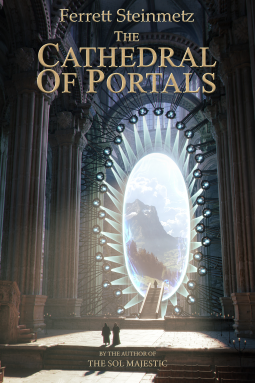
By Ferrett Steinmetz
Thanks to NetGalley, the publisher and the author for the opportunity to read and review this ARC.
it’s taken some time for me to get around to writing a decent review about this book. Sometimes I do that when I’m not sure how I feel about the quality of a book, but that is not the case here. This is a huge tome of a standalone, low fantasy novel. 988 pages is a commitment and as I’ve learned with modern novels, the length of novels can be a huge detriment to the final quality of the story. Not many novels deserve to be that long and some novels that push 500 pages need to tone it down. I can trust an author like Neal Stephenson, Tad Williams or China Mieville to use one thousand pages to their best advantage. But taking a chance on an unknown author may be a fatal mistake.
Luckily the author manages to pull it off. At no time did I feel that there was extraneous text added to make slow burn seem longer, or to explain things once again for the people in the back, or dump world building info that has nothing to do with the story at hand. This is just a big story with a lot of ideas. Low fantasy is generally a medieval type world, very little technology but also very little magic. in this case, a catastrophic event has occurred that has sundered the known world in half, and now the world occupies two separate but contiguous dimensions. This dimensional border is one of the few magical elements, some craftsmen are able to create ruins that chill or heat, depending on which side of the border the world occupies. Over the hundreds of years since the sundering, some mathematically talented individuals have been able to create small portals to travel or trade between the world, but the arithmetic is difficult and the resources to keep the portal open or to make it larger are expensive and difficult to mine. The windows can only be open for a limited time, and anything that gets caught in a closing portal will be neatly sliced in half. Many Portal Masters are missing fingers from math errors.
So both dimensions are aware of each other and there is limited trade between the two worlds. Trade that is very important as the world’s foremost religion is based on trade centred on a religious figure named the Peddler. The Peddler gave up his life rather than use his gold to fund the war that the Tyrant King (may his name never be mentioned) started. The religion of profit and trade is rather complicated, with the written word, tenets to follow to lead a more prosperous and profitable life. One may be tempted to compare it to Supply Side Jesus or the prosperity gospel, where christians worship money over other biblical instructions, but there really isn’t any comparison. What if capitalism was a religion and forced the people to conduct trade and business with ethic and morals? So, we see the religious side from the equivalent of a bishop,Philothea, who runs a rural marketplace and lives their life according the the Peddler’s teachings. When they learn of a terrible plot against the young queen, they decide to travel to the big city and talk to the equivalent of the pope for guidance. See, the religious are not supposed to meddle in the affairs of the nobility. But when he gets to the city he soon realizes that the church is also into the political game. Philothea must walk the thin line of politics while still remain true to their religion.
There are three factions at work in this world – The religious, the nobility (or political class) and the guilds. The guilds deal with anyone who makes things, the religious is about the sale and trade and markets. Any person that creates something at the behest of one of the other factions will be blacklisted from the guilds and unable to take on other work. And this is where we meet the second group of characters. Tesa is a portal master, but has taken on a private, non-guild sanctioned work for a noble lady. She is sure that she can create a portal that is self sustaining, meaning it will stay open with little to no need for the valuable crystals that the portals require. Unfortunately, the family’s patron dies before they are able to complete their project and they are forced out of the manor and left to fend on their own. Up to this point, Tesa has been supporting her family because she is the only one who has a talent worthy of guild membership, but since they were working off the books, Tesa, her wife and her children are cast out with no job prospects as they are blacklisted. They face starvation and worse with the snows coming, but Tesa is still determined to create a perpetual portal and her two older children are helping her, Riefan a genius with numbers and creativity and his sister Arla, not as smart but clever and conniving.
And this is just the beginning of the novel. At some point Tesa and Philothea’s paths cross and they figure out that large portal that can stay open so people can travel through at any time, bringing goods and services back and forth will be beneficial for all peoples. And so, they begin work on a huge gate, with Philothea managing the financing and Tesa running the equations, with Riefan and his mysterious friend Sky finding solutions to the toughest questions. Sky was first sent to the other world by a drunk portal master when she was a small orphan, who were used to squeeze through the smallest portals to run and grab anything unique for the portal master to sell for a profit on the other side. She stumbled into a mystery in the other world, and when she returned she stole the portal and spent many years tinkering with the contraption until she had figured it out in her own way. She eventually finds herself as part of this portal family and convinces Riefan to help he solve the mystery of the other world.
This novel spans years and covers all the setbacks and losses and betrayals as well as a race to the finish, but always working around the politics, like who should benefit from a gate? and other sticky questions. The novel follows several narrators as the story weaves around the building of the gate or what it takes to get there before anyone else. Everyone wants a piece of it when it’s done, even their counterparts on the other side.
At no time does this story drag. While the main storyline is all about the gate, there is so many other factors at work, with a boble rebellion gathering followers in the mountains and a small child left as the sole heir to the throne and kept int the dark as to what is actually happening so her advisors can continue to grift, as there are grifters and religious heretics at all levels of the administration. There is a love story in one major storyline, there is Tesa’s guilt in pursuing her vision at the cost of her relationship with her children. There are prison breakouts and mass destruction when gates fail and how does one redeem a life led in pursuit of power. ti’s a long story but well told. I read this much quicker than Astarian, which clocks in at a mere 266 pages but drags on every page.
While reading I was reminded Follett’s Pillars of the Earth, a large scale trilogy that focuses on the building of one of the largest cathedrals of the middle ages, an extraordinary undertaking between a mason and a bishop that follows the same political and religious themes, where the building creates huge waves in the underlying political, economical and religious firmanent of the entire breadth of society. I think Steinmetz carries off the big complex themes of this world at least as well as Follett and his massive trilogy.
Overall, I highly recommend this book, especially for a reader that wants to try something a bit more complicated than the usual fantasy or Romantasy novels. If one is a bit intimidated by the longer philosophical novels than I would recommend starting here. The concepts are not as dense as say Anathem or as scientifically precise as Seveneves or as alien as Perdido Street Station or as grand in scope as Dune, Red Mars or Tad Williams Oosten Ard books. You will get a good taste of what to expect from this book.
Rated 4.5 in Storygraph, but rated a 4 star on platforms where partial stars are not applicable.