By Tanya Huff
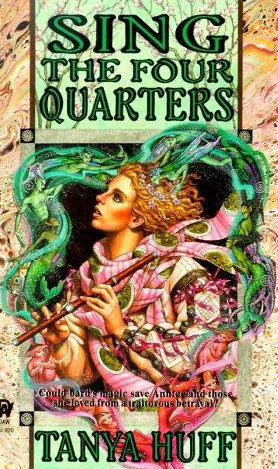
This month’s “old but gold” selection is a right on the cusp of 1995 – released December 1994, so this is about as contemporary as I’m going to get with these reviews. Tanya Huff has never done wrong by me with her writing, although I’ve never done a deep dive into her works, I have loved every book that I have come read in my long history of fantasy reading. Tanya Huff is a local writer so holds a special place in my heart, along with Guy Gavriel Kay, Robertson Davies and, um, Mara Leigh.
All joking aside, on a fantasy novel level this book delivers. The magic system is built around bards and music – where those born with the talent can sing to one or move of the four elemental beings called “Kigh” These elements,or quarters are wind, air, water and earth. Our protagonist is a rare talent who can sing to all four quarters and is also the sister of the king. She chose a life as a bard instead of being married off for political expendiency, and for that her brother cast her out of the monarchy, declaring, among other things, that any child she should bear would be considered a treasonous act . as carrying the blood of the royal family would also carry a potential claim on the throne. And so, we end up with a question of bodily autonomy, at the core of many feminist allegories, except instead of having to carry a child, Huff approaches the question from the other side, who can tell a woman that she cannot carry a child. So, be forewarned that our female protagonist spends the entirety of the story pregnant, which may be enough of a content warning for many readers.
Our protagonist, Annice, is in a live in, long term relationship with another female bard, but because they spend the majority of their time on the road, they have an open relationship and Annice is bisexual, so she indulges on the road – bardic magic is very visceral and sensual, so the bards tend to have very fluid relationships with their sexuality. A modern telling of this story would also play with gender norms, but in 1994 we didn’t have a cultural understanding of what transgender meant. Even this pansexual, polymoric type of relationship was still seen as very fringe behaviour. Tanya Huff was really pushing the boundaries of modern social mores of the time. Annice, during one particular long road trip hooks up with the very hot but very arrogant and self interest Duc of Ohrin. As she tells her partner – good for the night, but not one you’d want to have breakfast with. Of course, she finds out she is pregnant, and decides she wants to have this baby, to raise with her partner and has no plans to let the Duc know, or even more so, her brother who claimed it would be treason. Maybe she wants to keep the baby to spite her brother, the king, or in some fashion she wants a baby to replace the family she’s lost. Annice goes through a lot of reasoning, rational and irrational, but she still feels that she will keep the baby.
Meanwhile, the Duc of Ohrin has been double crossed by his aunt and the enemy kingdom and set up as a traitor by his own words (and a little bit of magic against his will) He’s brought to the capital to face the king’s justice, found guilty and sentenced to death. And while Annice does not plan to have the Duc involved in her life, she knows that there is something else afoot and puts herself at risk by helping him escape and travelling back with him to his realm in order to clear his name.
Overall, this is an excellent story. Completely self contained as as a standalone, the novel is full of action. Instead of two characters bickering endlessly as they travel cross country, there are plot twists and action sets that change the trajectory before the trekking scenes get monotonous. While they raise against time, the rest of the characters are also changing the narrative just by being smart and thinking ahead. It’s refreshing to read side characters with depth, instead of them being stubborn and refusing to do the work in solving the problem.
But is it a romantasy? I would say that this is a woman’s fantasy literature but it’s not a romance. There are no recognizable tropes. A modern romantasy would see this as a set up as “enemies to lovers” with the pregnant Bard and the arrogant Duc. But they don’t actually have romantic feelings for each other and other than that one night, they are far more concerned in keeping themselves alive then fucking each other. While the Duc has to come to terms that just because he unknowingly fertilized an egg he is not entitled to the child, but just as important, Annise discovers she can’t do things on her own and must reach out to others, it takes a village after all. She and her partner and the Duc end up creating an unusual family dynamic where everyone gets what they want. I think there are messages in here about alternative family structures and relationships and bonding beyond the “get married and have babies” ending.
Has it held up over the years? I don’t think that readers will find outdated tropes and ideas, since same sex, bisexuality, open/ poly-amorous relationships are expected in modern romantasy novels. Huff doesn’t dwell on the relationships, just that they are there and they exist. I’m sure reading this in the political environment of the mid 90s would have more impact on the reader, but today the reader will be more interested in the story, with all the relationship set up on the back burner. Luckily Huff’s writing is addictively good and hard to put down, so even if the conversation seems archaic to younger readers the story still carries the book.
I think that if a reader has a visceral reaction to pregnancy this may be a turn off as the pregnancy IS the main plot point. However, I do recommend that if the reader can put that aside they will enjoy the story. If you are a big fan of Robin Hobb, then Tanya Huff should be added to your TBR list.