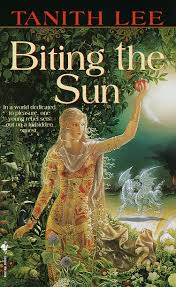
By Tanith Lee
DO NOT BITE THE SUN,
TRAVELER,
YOU WILL BURN YOUR MOUTH
For this iteration of “Old but Gold” I travelled way back to 1977 for {Biting the Sun by Tanith Lee}, her debut novel – this version released in 1979 has both books of the duology {Don’t Bite the Sun} and {Drinking Sapphire Wine}. Tanith Lee is a huge name in the origins of Fantasy Romance and I may pick a few novels written by her over the years. I think the first books I read of her were her reimaginings of Snow White in the 80s. But many romantasy writers will call her out as an early influence and she has a huge body of work that is loved by romantasy, SF, Fantasy and Horror fans.
Don’t Bite the Sun, the first book in the duology, is an excellent example of new wave SFF that came out of the late 60s to 70s, when women, queer and other marginalized groups used speculative fiction as a place to play with allegorical themes and examine ideas that were not found in mainstream literature. Themes of homosexuality, sexual proclivities, alternative lifestyles and political ideas could be explored within a fantastical setting. A reader could enjoy the story as it is, or think about what the author is trying to say.
The immediate feeling when beginning the novel was delight in being able to immerse into a strange futuristic world, maybe another planet but maybe Earth several millenial in the future, but it doesn’t matter. Humans live on a desert world in 3 large domed worlds – four BEE, four BAA and four BOO. Lee doesn’t waste time explaining the world; the reader is put into the POV of our unnamed protagonist, a jang, basically an adolescent, where adolescence lasts for 25 to 50 years or beyond. No one actually dies anymore, technology has evolved to the point where a human’s life force, or ‘soul’ can be plopped back into any body of your choice. It also means that you can change your body at will, switching genders and looks as to your preference. The community is managed by robots and humans have nothing to do but whatever they want. There is a childhood stage, then jang stage, then, when you have been deemed ready, you can move on as a Older Person, a misnomer of course, as you can look however you’d like, but as an older person you have grown out of the extremes of the jang.
The jang phase is about experimentation of all types – sexual, gender, drugs, leisure – even sabotage and stealing is encouraged, at least tolerated, just to get it out of your system. There are a few traditions and rules, and the robots that manage the safety and management of the system will gently guide one back to proper behaviour according to your social group. Is this a comment on society forcing its will on the individual? The lack of empathy of the authority class? What makes one human if leisure, sex, drugs and music is unfulfilling? Humans no longer need to work, but if they feel the need to be productive, you can work once you are finished with being a jang, but not before and “work” consists of pushing buttons, that could be automated, but are not, because there is a need for humans to be occupied.
Don’t Bite the Sun is a coming-of-age novel, but do not dismiss it as young adult. The themes of late adolescence, at least the questions I asked myself, are there – the ennui of life, the pressure of society to conform, the disillusionment of friend circles and cliques, the realization that love and adoration of others is not enough to sustain one’s mental health. Our protagonist sits on the precipice between maturity and childishness. The quote above is from an ‘ancient’ shard of pottery, but for our protagonist it’s a warning – that biting the sun is trying to consume too much will never fulfill you, but instead will burn you. (over consumption will consume you, a feminist idea that is further explored in novels such as The Edible Woman by Atwood, published in 1969)
I think you will find that the answer to your problem is to throw yourself more wholeheartedly into Jang pursuits. Fill your time. Stop thinking: ‘I must be joyous,’ and then hating everyone when you fail to achieve joy in this manner. Relax
– one of the community managing robots in response to the protagonists depression.
Just chill, dude.
Our protagonist is not the only human to feel empty and disillusioned and outcast. The second book she (as she is Predominantly Female, as characters refer to each other even though they switch genders at will) finds herself outside the domed cities and inspiring other outcasts to join her to live a more fulfilling life in a commune of their own making. It’s really a book about found family and even has a HEA with a partner she may have even found love, real love, not synthesized.
Overall these books are excellent. For a reader not used to early SFF there may be a bit of a learning curve being dropped into the story without much explanation, but the edition I had includes a glossary that explains some of the more confusing aspects like time units and customs, but there are many things that are not explained. The best way to read is to just jump in and immerse yourself in the story.
Does it translate well into modern life? Once someone tried to argue with me that {Left Hand of Darkness by LeGuin} was transphobic because of her “heavy handed” treatment of trans people, completely overlooking that there wasn’t a word for gender fluidity because it wasn’t a thing talked about in polite society. Which makes this era of SFF so groundbreaking for portraying same sex relationships, gender fluidity, identity and sexuality. Put in the future on another planet, but the questions are the same. Lee’s writing is way ahead of her time. The only part that made me raise my eyebrows was referring to one of her friends that was unable to find joy in sex as “Frigid”, when the character just couldn’t be intimitate with anyone, in male or female form, unless she loved them. When she does fall in love, it’s with an Older Person, which is taboo in their society, less for the age difference, as we’d feel the ick today, but because Jang are a different social class and should not interact with others. When people can live forever, this would be the equivalent of your 1400yr old fae and if we can accept that, this shouldn’t be seen as an unacceptable age difference.
I struggled with the rating on this, originally I was 4.75, but I think I will upgrade to 5/5 since I haven’t been able to stop thinking about it.

You know a book had an impact on you when you can’t stop thinking about it!
Ohhh noooo, not The Olds!
Ohhh noooo, not The Olds!
Did my second comment go through?