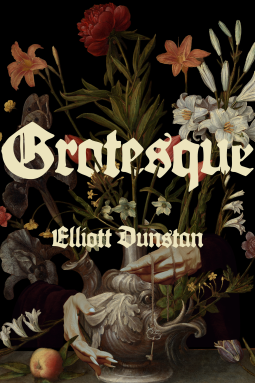
by Elliot Dunstan
Thanks to NetGalley, the publisher and the author for the opportunity to read and review this ARC.
There are many reasons why I might select a novel to read before the official release date Sometimes it is just for the chance to be “FiRSt!!1!” Sometimes I want to read it to make my own opinion before there is too much chatter about it in public places. Sometimes I want to access something new and different and creative, to be on the cutting edge of what is happening in the literary genre where I do most of my reading. I love the challenge of choosing a book with nothing more than a cover, a title and a short blurb and seeing where it goes. Lucky for me, I have a good picker sense and end up with far more positive experiences than negative.
I will fully admit that Grotesque caught my attention by the title alone, a good first start if the novelist is clever . It could be a dark carnival or an allegory with ugly monsters, where the word suggests a story of “the other” of society, the hidden, the ugly, the freaks that are objects of fascination and shame of a society. The description is vague, we’ve got Cornwall, and monsters and gods and potential world destruction, but it had the word “Golem” and I was immediately interested as Golem stories tend to revolve around my own culture’s mythology. I had just finished the final book in Helen Wecker’s The Golem and the Jinni series and was not ready to let go of the Golem story. And finally, the author is Canadian, a trans poet, performer and visual artist and I want to explore new voices and promote them if I can.
The opening of the novel reads more like erotica than a typical romance of this genre. Both literally, as it opens with our golem who is a sadist creating a scene with a client in a sex club. When I say “erotica” I do not mean that in a derogatory pornographic manner, but in how the scene is described to the reader, in a dreamy, poetical prose that is a mixture of sex and art. The readers are introduced to our golem while he describes the pain and desire he inflicts on his client. At the end of the session, the client asks for his name which is does not give as names are personal and intimate and suggests feelings that a golem does not have. Other things a golem does not have is an assigned gender, they appear androgynous but prefer to dress as a man and use he/him pronouns.
From there we flash back 200 years when our golem was newly made, before his master left. We learn that they were built and deferred to as a woman and wears dresses as that is what their master has given them. They don’t have a concept of their gender, they were built to serve, although a golem is traditionally created to protect, but his master is not Jewish and has twisted the will of the talmud to create a servant not a shield. Our golem meets a royalist soldier, running from their own ghosts, who is black and sees in the Golem a fellow outcast, a being who will never fit into society for being other. The soldier gives the Golem the gift of choosing his own name – Denvyth – which means ‘no one’ in the Cornish language. Denvyth feels connected to this soldier, as much as an automon made from clay can feel. This angers Denvyth’s master and he punishes him by storing him away for at least a decade until the soldier is long gone.
From that point on, we go back and forth in the novel, learning how Denvyth meets up with a Siren who collects magical outcasts and hires them to work in her sex club, that his master disappeared shortly after meeting the sailor, and how loneliness weighs heavily on Denvyth who can only remain on the edges of society, ever present but never part of it, how he meets others, like the jewish woman who wishes she could study the Talmud, or the girl who tried to kill herself because she was born in a boy’s body and her father beat her for it.
Meanwhile, in the present day of the novel, his regular client who has asked him for his name carries secrets and answers to Denvyth’s past and his purpose. He is a creature created for a monstrous purpose which he cannot ignore . That leads to questions like whether the slave can be a monster, what is the nature of his heart if a golem is built to protect but has been corrupted to be something else.
I think this is a book about identity and whether we need to accept who we are as an accident of birth, or creation, gender or race or sex, human or magical creature, master or slave, god or monster, or whatever those spaces are between. These are deep questions but they are told in a story that is so visceral, a tale of sex and violence and beautiful prose. The Gothic, and dark fantasy readers will love this but anyone who has experienced love and acceptance among the community of the outcast will also find the novel compelling and hopeful.
I gave this a 4.5 review in Storygraph,which I’ve rounded down to a 4 star review in applications that do not permit partial stars. it’s an excellent debut.