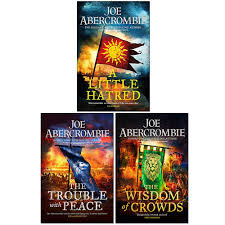
By Joe Abercrombie
The Age of Madness series consists of three novels: A Little Hatred, The Trouble with Peace, and The Wisdom of Crowds
I read The Blade Itself by Abercrombie around the time it came out and it was a complete game changer for me in terms of what fantasy could look like, and where it was going. Gritty, dark and morally ambiguous, It was fantasy for adults and after a decade or so of the fantasy genre going on a middle school and YA bender and drunk on the proceeds of the media attention of Harry Potter and that ilk, Abercrombie’s writing was an oasis in the desert of what the fantasy genre had become.
It still took some time for fantasy to shake off the YA curse (one of these days I’ll post a rant about the chokehold YA has had on the fantasy genre) but The First Law trilogy was a great start.
In the years following I got caught up in other things and did not read as much (ok, I was binging other types of media in my free time) then I got into the Sloopy reading business which does not include ‘Grimdark’ content, or whatever you want to call that particular subgenre. It’s dark, it’s edgy and violent, it’s mostly written by boys for boys (although most of the fantasy genre has been like that, and these books should not be written off as only for boys) and it’s subversive and funny. Like romantasy, there are a number of tropes that are specific to ‘grimdark’ fantasy but also, like romantasy, it’s not that easily defined and has great writers, good writers and not so good writers with fans not always agreeing on the definition of what is good or even what makes a novel ‘grimdark’.
If cozy fantasy with a meet cute romance, no high stakes conflict and no violence is your jam, stay away from ‘Grimdark’. I actually can like both and it depends on what mood i’m in as to which direction I will go. We should all have a balance in our reading portfolio. If you’ve never read anything grimdark or Abercrombie I suggest picking up The Devils and if that seems a bit overwhelming still, pick up the audiobook with the extremely talented Stephen Pacey as narrator.
The Age of Madness trilogy is actually books 7 to 9 set in the world of the First Law that starts with The Blade Itself trilogy, then three standalone novels before we get to the events that occur in the first book A Little Hatred. Could you start your First Law journey here? It’s possible, as its been nearly 2 decades since I read the initial trilogy and did not read the standalones. The main characters in the books are basically the grown children of characters of the previous books, plus a few old-timers who had major roles in earlier books (Caul Shivers, Bremer Dan Gorst, Sand Den Glokta) and a whole cast of new characters. I’m very quick to pick up on history and clues to past events with the breadcrumbs that Abercrombie gives the reader to keep the narrative straight, but I think I’m an outlier here in my outright refusal to re-read books and demand the author to keep me in the loop. I have also read hundreds of fantasy books over the years and I’m much quicker to pick up tropes and extrapolate past action from current action. I think for most readers it will be best to start at the beginning unless you are freak like myself. Even so, I did have to check the Wiki after each novel to get a better understanding of some of the characters backgrounds and motivation. (I learned not to check before reading as I got a major spoiler and had to pause my reading for a few days because I was upset)
I do think you can skip the standalones to get to this trilogy and if you have done that, or you are not sure if it’s worth it to continue the series, let this review be for you.
The books are a loose sketch of the French Revolution, with a bored and overly powerful but ineffectual ruling class, a bourgeoisie merchant class that has more money then they can spend, but still looking for more ways to make money while crushing the working and poor underfoot. The industrial age is beginning with rural refugees moving into the cities and taking work while a general unease and seething violence underlies everything. There is war on the borders, a threat to the north and a never ending war for no reason to the east. The women are over done in wigs and corsets and makeup, but not in power. The sense of time and place is its own character in these books, but we are also introduced to a number of characters in all the various parts of this world, many of whom are the scions of the last great conflict that occurred 30 years ago in this world. But this is a wholly different story with new focuses, new alliances and new ideas.
I also think that the writing has become more modern from the original trilogy. These books were released 2019 to 2022 and we see more women as strong central figures and more romance sub plots. There is more diversity in sexuality than a reader would have seen 20 years ago. I can’t do an exact book by book comparison because I read the originals in their time, but I would not be surprised to see less nuanced takes on gender and sexuality in the first trilogy. This is not a comment on the author changing their point of view, but just the natural societal change over time. We read more romantasy, fantasy is affected by this and a romance sub plot is better written these days because I think authors are learning what readers want to read about.
But Abercrombie, and other so called ‘grimdark’ authors tend to gravitate to some common tropes in the genre. First of all is the dark humour. Whether you call it Gallows humour, or black comedy, wry, sardonic, cynical or sarcasm, it’s taking dark subjects and finding laughs among it. Some readers find this inappropriate around violence, but for those who like to laugh in the face of horror, Abercrombie is a master of being hilarious and disgusting at the same time. There are a lot of sexual jokes, there are wry comments about bodies, love, relationships as well. I like to think it’s realistic but it’s not idealistic. There is also suffering – suffering in love interests as well as death, violence and falling apart due to the trauma of the situation. There is cheating and other women drama and sexual assault and incest and hate fucks. This is not a good time in history to build a good moral back story.
The great part of these books is the humour played up against the horrible scenes being played out in the factories, in the wars, in the poor houses. Since this is based on the French revolution, there is a reign of terror where everyone is put to death for perceived crimes. The method is not by guillotine but through means just as barbaric, bloody and cruel. And then we laugh at the next scene.
The characters themselves are not perfect. Those with a strong moral centre are usually doomed to fail, or pressured to make immoral or impossible decisions . Characters that are evil are also lovable; innocents are irrevocably moved towards evil acts. Characters that start out as useless entities gain emotional weight so their end game is emotionally wretched. A loveable character spouts racist, sexiest and homophobic sentiments. The main characters move from good to evil to good with regularity so that the reader cannot make a judgement on whether they should love or hate them.
But all this ambiguity is what makes the trilogy so wonderful. The writing is fabulous, the pacing never slows down and Abercrombie uses some literary narrative flim flammery like jumping from character to character in a battle scene that makes the reader feel like they are actually travelling through the battlefield to get a 360 degree view of war that is gross and funny and makes your heart race as you race from a peasant pikeman, to general, to message bringer to beserker from side to side. It’s just a brilliant device and before you know it four hours of audio has been used to describe one battle.
Just to wrap up, I’ve read Abercrombie in print which is wonderful, but he also has Stephen Pacey as a narrator for all of his books and he is brilliant in capturing a huge cast of characters and POV characters. It’s a completely immersive experience and while the books are close to 30 hrs of listening each, it’s worth it the journey.
In the end, the actions of the trilogy are complete but also opens a door to the next set of adventures with a new generation, so we haven’t seen the end of this world yet. And as long as it works, I’m there for it.
As far as rating goes, some of the books I gave 4.5 to 4.75 ratings but the series as a whole is a 5 / 5 read, which is why I decided to review as a series instead of individual books.